How Portland Soil Affects Your Underground Pipes
The Ground Under Your Home Is Not Sitting Still
Most homeowners think about their plumbing in terms of what is inside the walls. But a significant portion of the water system runs underground, through soil that is constantly changing. In the Portland area, that soil movement is one of the leading causes of pipe stress, joint failure, and underground leaks over time.
Understanding how Portland soil behaves and what it does to buried pipes helps explain why older Portland homes develop underground leaks even when the pipes themselves are not especially old.
What Kind of Soil Does Portland Have?
The Portland metro area sits on a mix of soil types, but clay-dominant soil is the most common, especially in residential neighborhoods on the west side of the Willamette and in much of Washington County and Clackamas County. Clay soil has a specific characteristic that directly affects underground pipes: it shrinks and swells dramatically based on moisture content.
When clay soil absorbs water during Portland winters, the particles expand and the soil increases in volume. This expansion exerts pressure on anything buried in it, including water supply lines, sewer laterals, and irrigation pipes. When the soil dries out during summer, it contracts and pulls away from those same buried pipes. Over one year, a buried pipe in Portland clay soil can be squeezed during the wet season and left unsupported in an air gap during the dry season.
Over ten or twenty years, that cycle repeats hundreds of times. Each cycle is another opportunity for a joint to loosen, a rigid pipe to crack at a stress point, or a flexible pipe to develop a fatigue failure.
The Wet Season: Soil Expansion and Pipe Pressure
Portland winters bring sustained heavy rainfall. Between November and March, soil moisture levels stay high for extended periods. Clay soil in this condition swells noticeably. In some areas, the ground surface actually rises slightly during wet winters, a phenomenon called soil heave.
For buried pipes, this means lateral pressure from all sides. A rigid pipe like old galvanized steel or cast iron drain pipe cannot flex to accommodate this pressure. Over time, the pipe cracks at points where the pressure is concentrated, typically at joints, bends, and places where the pipe transitions from one material to another.
Plastic pipes like PVC and PEX have more flex and handle soil pressure better than rigid pipe. But even plastic pipes at joints and connections can fail if the soil movement is significant enough or sustained over many years.
The Dry Season: Soil Contraction and Unsupported Pipe
By July and August, Portland experiences its characteristic dry stretch. The same clay soil that expanded during winter now contracts and shrinks. Cracks appear in the soil surface. Ground that was firm and dense in February becomes fissured and loose by August.
Buried pipes that were surrounded by dense, supportive soil are now partially unsupported. They may settle slightly as the soil below them shifts. A pipe that runs at a consistent slope can develop a belly, a low spot where water pools instead of flowing, when the ground shifts unevenly beneath it. Drain lines with bellies trap sediment and eventually clog or back up.
The contraction also pulls pipe joints slightly. A joint that was snug during the wet season is now under slight tension as the surrounding soil pulls away. Repeated tension and relaxation cycles fatigue the joint sealants and gaskets over years.
Tree Roots: The Underground Enemy
Portland is a famously tree-canopied city. Those trees are beautiful. Their roots are not always friendly to underground plumbing.
Tree roots grow toward water. A buried pipe that has even the smallest leak releases moisture into the surrounding soil. That moisture gradient draws roots toward the pipe. Fine feeder roots can penetrate microscopic cracks in clay pipe, cast iron, and even older PVC at joint seams. Once inside, roots grow and expand, widening the crack and causing the pipe to fail further.
The most vulnerable pipes to root intrusion are clay tile drain lines, which were commonly used for sewer laterals in Portland homes built before the 1960s. Clay tile pipe is jointed in short sections with gaps between each section. Roots enter at these gaps easily. By the time a homeowner notices slow drainage or backups, the roots inside the pipe may have been growing for years.
Even supply lines are not immune. A pressurized supply line that develops a pinhole leak can attract root growth toward it. Roots cannot enter the pipe itself while it is under pressure, but they wrap around it and can crack it further at points where the pipe is already stressed.
Street trees, particularly the large established trees in many Portland neighborhoods, have root systems that extend well beyond what the visible canopy suggests. The roots follow water and nutrients, which often leads them directly toward sewer and water lines running under the sidewalk and yard.
Soil Acidity and Pipe Corrosion
Portland area soil tends toward slightly acidic pH, particularly in areas with heavy vegetation and decomposing organic matter. Soil acidity accelerates the corrosion of metal pipes from the outside. Galvanized steel and cast iron pipes buried in acidic soil corrode on the exterior at the same time they corrode on the interior from water chemistry and mineral deposits.
This two-directional corrosion is one reason why old galvanized steel pipes in Portland fail faster than the same pipe installed in neutral or alkaline soil conditions. The pipe wall thins from both sides simultaneously. When it finally cracks, it can do so suddenly rather than developing a slow pinhole first.
Copper pipe is more resistant to soil acidity than galvanized steel, but it is not immune. Copper buried in highly acidic soil, or soil with high sulfate content, can develop external pitting corrosion over decades. This is less common than internal pinhole leaks in Portland copper, but it is a factor in some specific soil conditions.
Fill Soil: The Hidden Risk in Newer Areas
Parts of the Portland metro area, particularly in newer subdivisions built on former agricultural land, industrial sites, or areas that were graded and filled, have fill soil rather than native soil. Fill soil is less stable than native ground. It settles and compacts over years as the fill material consolidates under the weight of structures and rainfall.
Homes built on fill soil experience more soil movement than those on native ground, even if the fill was compacted properly at construction. Underground pipes in fill areas are subject to more settling and movement than the same pipes in established neighborhoods on native soil. This is one reason why some newer homes on filled lots develop underground pipe problems earlier than their age would suggest.
What This Means for Portland Homeowners
The combination of clay soil movement, root pressure, soil acidity, and seasonal wet-dry cycles means that underground pipes in Portland work harder than pipes in many other parts of the country. A pipe that might last 60 years in a stable, dry climate may show stress and failure at 40 years in Portland conditions.
This does not mean your pipes will fail tomorrow. But it does mean that if your home is more than 30 to 40 years old and has original underground plumbing, the soil has been working on those pipes for decades. Regular monitoring makes sense.
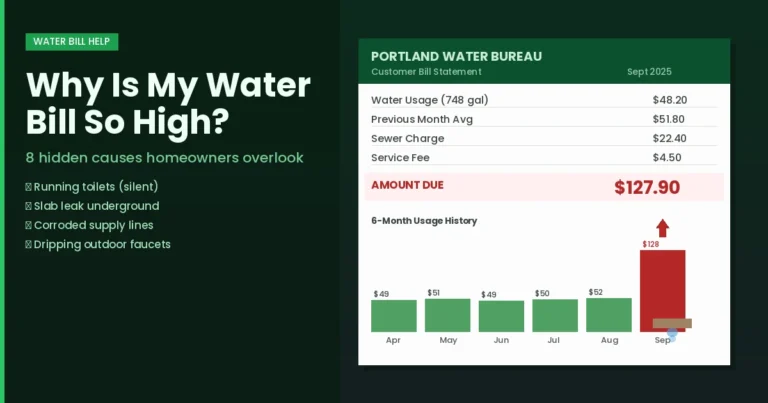
The most practical thing you can do is watch your water bill and do a meter check periodically. A sudden or gradual increase in usage that does not match your household habits is often the first sign that an underground pipe has developed a leak. Catching it at that stage, before significant soil erosion or surface damage appears, keeps the repair targeted and affordable.
For drain lines, slow drainage throughout the house (not just one fixture) and occasional backups are signs that tree roots or soil settlement may have compromised the sewer lateral. A camera inspection of the lateral can show exactly what is going on without any digging.
For supply lines, the meter test remains the simplest and most reliable self-diagnostic tool. Turn everything off, watch the meter, and see if water is moving. If it is, the soil may have finally worked its way through a joint or a corroded pipe wall, and a professional inspection will confirm where.