

Underground Leak Detection PortlandFind the Break Before You Dig.
Your water bill climbed and nothing inside the house changed. There is a soft wet strip across the lawn that never dries. Your pressure dropped and every tap feels a little slow. These are not separate problems. They are one buried leak, somewhere between your meter and your foundation. Portland homeowners call us for underground leak detection Portland trusts — accurate location, documented results, no guessing, no unnecessary digging.
(503) 914-2356 — Call NowWhat Are the Signs of an Underground Water Leak in Your Yard?
Most homeowners searching for underground leak detection Portland find the same thing: the signs are there, but they never pointed clearly at a buried pipe. Underground leaks look nothing like a dripping faucet. The water is moving through soil and gravel before it ever reaches the surface, which means the visible signs are easy to misread as something else. A patch of grass that stays unnaturally green in August. A shallow pool forming along the edge of the driveway after two dry weeks. A sidewalk that heaves upward with no freeze-thaw to explain it. These are the signs that bring Portland homeowners to search for underground leak detection Portland.
Can a buried leak stay hidden for years?
Yes. Slow pinhole leaks in buried copper or galvanized pipe can release water for months before any surface sign appears. The soil absorbs it. The lawn covers it. The bill climbs gradually enough that it takes a few cycles to notice the trend.
One section of lawn that stays bright green while the rest browns in dry weather
Unexplained puddle or soggy patch along the foundation, driveway edge, or sidewalk
Water bill that rose without any change in how the house is used
Pressure drop at every tap — shower, kitchen, laundry all feel weaker than normal
Sound of rushing water near the meter box or foundation with every tap off
Concrete or asphalt heaving or cracking along the water service path
Rust-colored staining in the soil near where your service line runs
Meter spinning slowly with all fixtures shut off
Who Is Responsible for an Underground Water Line Leak in Portland?
This question matters before anything else, and almost no one in Portland knows the answer until they have a leak. Portland Water Bureau owns and maintains the water main running under the street. Everything from the tap on that main to the point where water enters your home is yours. That includes the entire buried service line crossing your yard, under your driveway, and beneath any concrete between the street and your foundation.
The Portland Ownership Rule: Meter to Main Is Theirs. Meter to House Is Yours.
The curb stop and the meter belong to Portland Water Bureau. The buried pipe running from that meter to your foundation is your responsibility to maintain and repair. A leak anywhere along that run — even under a city sidewalk — is typically yours to fix. We document the location precisely so you know exactly what you are dealing with before you call a plumber or an attorney.
Will Portland Water Bureau give a bill credit for an underground leak?
Sometimes yes. Portland Water Bureau has a leak adjustment program. If you can show a documented sudden spike, a professional detection report, and proof of repair, they may credit one billing cycle. Call their customer service line after we give you the written report. The timestamped documentation we provide is what makes that conversation possible.
Why Underground Leaks in Portland Are Different From Any Other City
The pipe under your yard has been dealing with Portland-specific conditions for decades. Three of them accelerate failure faster than anything a general plumber will mention when they quote the repair.
Galvanized Steel Pipe From the 1920s Through the 1950s
Walk NE Alberta Street, N Lombard, or SE Woodstock and look at the build years. Homes from 1920 to 1955 were commonly plumbed with galvanized steel service lines. That pipe corrodes from the inside out. After 70 years in Portland’s clay soil, the inside wall can be nearly closed with rust scale, and the outside can be pitting through. A pinhole in galvanized pipe underground is not a one-time fix. It is the start of multiple failures along the same run.
Tree Root Intrusion in SE and NE Portland
Portland’s urban canopy — the elms, oaks, and maples that line SE Hawthorne, NE Fremont, and N Mississippi — have root systems that travel 30 to 50 feet from the trunk in search of moisture. A joint gap in a buried service line is exactly what a root system finds first. The root enters, grows, and eventually splits the pipe. Underground leak detection in Portland frequently finds tree roots as the source in older neighborhoods where the canopy and the original pipe were planted in the same decade.
Willamette Valley Clay Soil and Seasonal Pipe Stress
The same clay soil that makes Portland gardens productive puts buried pipe under mechanical stress every year. Wet winters swell the soil around buried lines. Dry summers shrink it. A pipe joint that holds through a wet March can open a stress crack when July pulls the clay away from it. This cycle repeats every year, and older pipe joints that have already weakened from corrosion fail faster when the soil moves around them.
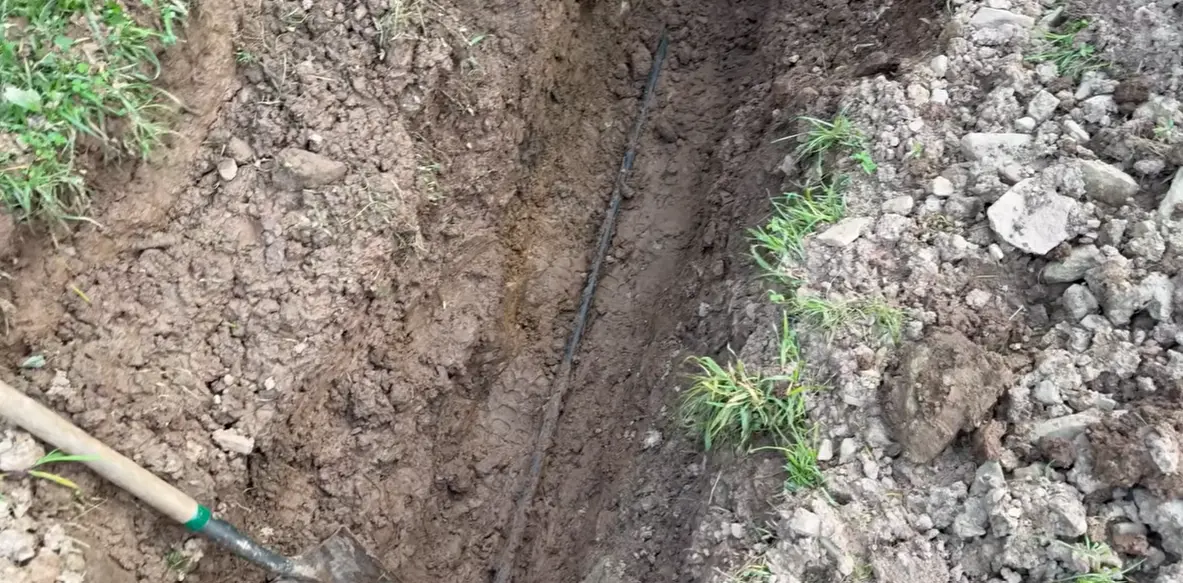
How Long Can an Underground Water Leak Go Undetected?
Portland’s rain from October through May is the main reason calls for underground leak detection Portland spike every June, not February. The leak is running all winter, but it takes a dry stretch for the signs to appear. An extra wet patch in the yard blends into a city that averages 36 inches of rain a year. Most homeowners who call us for underground leak detection Portland notice the problem in late June or July, when the lawn is supposed to be dry and one strip stays green. By that point the leak has often been running since February or March.
The damage underground is soil erosion beneath your driveway or foundation. Water removes compacted fill and leaves voids. Pavement sinks. Concrete cracks. What looks like a settling driveway in Sellwood or a shifting walkway in Irvington is sometimes a buried service line that has been leaking into the base for a full season.
What happens if an underground water leak goes unfixed?
Erosion under driveways and walkways creates voids that collapse. Wet soil undermines shallow foundations. Over a full season, a leaking galvanized service line can soften enough base material to cause pavement failure that costs far more than the pipe repair would have.
How Do You Detect an Underground Water Leak Without Digging?
Buried pipe is anywhere from 18 inches to 4 feet below grade in Portland. You cannot see it. You cannot reach it without equipment. Three methods each solve a different piece of the puzzle, and which one we use depends on your pipe material, your soil type, and where the leak is most likely hiding.
Underground leak detection Portland homeowners need is not the same as a standard plumbing inspection. The equipment is different. The training is different. And the result — a marked location before any shovel touches the ground — is what controls the repair cost.
Acoustic Correlator for Metal Pipe
We attach sensors to two access points along a metal service line — the meter and a valve at the foundation. A correlator measures the time it takes for the leak sound to reach each sensor and calculates the exact position of the break by the difference. On galvanized and copper pipe, this method pinpoints a break to within 12 inches without touching the soil above it.
Ground-Penetrating Radar for Plastic Pipe
PVC and HDPE lines installed in Portland homes from the 1980s onward do not carry sound the way metal does. Ground-penetrating radar sends a signal through the soil and reads the reflection. Wet soil around a leak reflects differently than dry compact fill. GPR shows us the pipe path, the break location, and the depth — all from the surface with no digging required.
Tracer Gas for Deep or Covered Lines
For breaks buried under concrete, asphalt, or more than 3 feet of soil, we seal the pipe, pressurize it with inert gas, and trace the gas plume as it rises through the ground. The surface detector follows the concentration peak directly above the break. Used specifically on lines that run under driveways, walkways, and foundation slabs where other methods cannot reach.
811 before any dig in Oregon: Oregon law requires a utility locate call to 811 at least two business days before any excavation. We file that notification as part of our service. No shovel goes into the ground on your property without marked utilities. That protects your gas line, your electrical conduit, and your neighbors. It is not optional — it is Oregon law.
How Underground Leak Detection in Portland Actually Works: Step by Step
Pipe Material and Path Confirmed
Before we arrive, we ask your home’s build year and whether the service line was ever replaced. Galvanized (pre-1960), copper (1960s–1980s), and plastic (1980s+) each require a different detection method. We bring the right equipment, not a generic kit.
Meter Isolation Test
We confirm the leak is on your side of the meter and rule out interior fixtures. Meter reading taken with every tap off, then again after 30 minutes. Movement confirms an active underground loss. We also pressure-test individual zones if your system allows isolation.
Surface Scan and Pipe Trace
We walk the service line path with a pipe locator to confirm routing. Many older Portland properties have lines that don’t follow the most direct route — they route around additions, mature trees, and old outbuildings. Knowing the exact path prevents scanning the wrong area.
Signal Correlation or GPR Scan
Correlator sensors go on both ends of the service line. On plastic pipe, the GPR antenna passes over the confirmed path. Both methods produce a signal map. We read the peak and calculate the depth. Two methods cross-checking each other gives us the accuracy to mark before any digging begins.
Location Marked and Documented
The exact break point is painted on the surface. Depth is noted. Dated photos record the scan pattern, the signal reading, and the marked spot. A written report goes with you the same day. That document is what you give your plumber, your insurance adjuster, and the Portland Water Bureau if you apply for a bill credit.
Repair Options Explained
We tell you what the break looks like, how deep the pipe runs, and whether trenchless repair is possible or a direct excavation is the better path. We work with your plumber or we can refer you to one who has worked from our reports before. The goal is one dig at the right spot, not three guesses.
Can You Detect a Leak Under a Driveway or Concrete Without Breaking It?
Yes, and this is one of the most common situations we handle. Underground leak detection Portland work runs under driveways, walkways, and poured patios regularly — it is the scenario where GPR and tracer gas earn their fee most clearly. Many service lines run under the driveway between the street and the garage. Breaking concrete to find a leak by sight is expensive — not because of the pipe repair but because of the concrete replacement. Getting it wrong means cutting in two or three places.
Tracer gas and GPR both work through concrete and asphalt. We seal the line, pressurize it with inert gas, and run the surface detector along the driveway. The concentration peak tells us exactly where the break is and how deep. The repair crew cuts once at the right spot. One cut. One repair. One concrete patch.
How deep are underground water lines in Portland?
Service lines in Portland are typically buried 18 to 36 inches below grade. Lines under driveways are often deeper — 24 to 48 inches — to handle vehicle load. Our report includes depth measurement, which determines whether trenchless lining or direct excavation makes more economic sense for the repair.
Real Underground Leaks We Found Across Portland
The Situation
A 1938 bungalow near SE Tacoma Street. Original galvanized service line still in place. Water bill doubled over two billing cycles. A strip of lawn near the foundation stayed wet through a six-week dry spell. No visible surface water, no indoor signs.
What We Did
Correlation sensors attached at the meter and the main shutoff inside the garage. Signal peaked 14 feet from the foundation, 26 inches below grade. GPR confirmed no other anomalies along the run.
The Outcome
Plumber excavated one spot, found the galvanized pipe pinholed through the wall at the marked location. Entire service line replaced with copper. Bill normalized within one cycle. Portland Water Bureau adjustment applied.
The Situation
1924 Craftsman off NE Hancock Street. Pressure dropped at every fixture over three months. Concrete sidewalk along the property line had a new crack running parallel to the street. Meter spinning with everything off.
What We Did
Pipe trace confirmed the service line ran closer to the sidewalk than expected — routing around a mature oak. Correlator found the break 8 inches from the sidewalk edge, 20 inches deep. Root intrusion confirmed at the joint.
The Outcome
Trenchless spot repair completed without disturbing the sidewalk. Root treated and pipe lined at the break point. Pressure restored same day.
The Situation
A 1960s ranch home on a sloped lot. Water meter showed constant movement. No wet areas visible because the slope drained the seepage downhill before it pooled. Homeowner had already paid one emergency plumber who found nothing.
What We Did
GPR scan on the uphill service path found the break 38 inches below grade under a concrete walkway. Tracer gas confirmed the location precisely. No surface pooling because the slope carried water away before it reached the grass.
The Outcome
One cut through the walkway. Copper pipe replaced at that section. No further excavation needed. Written report submitted to homeowner’s insurance.
What Portland Homeowners Say
“Our water bill was $400 over what it should have been. The city couldn’t help. A general plumber couldn’t find it. These guys came out and marked the exact spot in two hours. One dig. Fixed. Bill went back to normal.”
“The driveway started sinking and I thought it was just age. They found a leak under it that had been washing out the base for months. The report they gave me was what convinced my insurance company to pay.”
“I hired a plumber first. He dug in three spots and didn’t find it. Then I called these guys. They found it in one pass and marked it. The plumber dug once more at the right spot and it was done.”
Underground Leak Detection Across Portland Metro
For underground leak detection Portland metro homeowners can count on seven days a week, same day in most cases. Service lines, irrigation mains, and buried laterals across the metro.
SE Portland
Sellwood, Woodstock, Division, Hawthorne. Heavy galvanized pipe era, deep tree root systems, older service lines.
NE Portland
Irvington, Alberta, Fremont, Concordia. 1920s–1940s homes, mature canopy root pressure on buried joints.
N Portland
Kenton, St. Johns, Lombard corridor. Original service lines still in place on many pre-war builds.
SW Portland / Terwilliger
Sloped lots, deeper service lines, basalt substrate in upper West Hills. Drainage patterns can hide pooling.
Beaverton
Murray Boulevard, Walker Road, Cedar Hills. Postwar construction with copper service lines now 50+ years old.
Lake Oswego
Boones Ferry Road, Lake Grove. Mixed copper and plastic service lines, pressure zone boundaries.
Tigard
Pacific Highway corridor, Bull Mountain. Clay soil movement common along service line paths.
Gresham
East of I-205. Older water district infrastructure with mixed pipe materials and fewer replacement records.
Milwaukie
SE McLoughlin Boulevard corridor. Service lines that cross older concrete flatwork before reaching foundations.
Underground Leak Detection Portland — Questions We Hear Every Day
Wet Yard. High Bill. Meter Moving. Call Now.
Your service line is somewhere between the meter and your foundation, and right now it is losing water into the soil beneath your property. Underground leak detection Portland homeowners rely on is what we do every day — across Sellwood, Irvington, Beaverton, Lake Oswego, and every neighborhood in between. We find the exact break, mark it precisely, document it fully, and hand you a repair path that does not involve three wrong guesses in your yard.
Same-day available · CCB Licensed Oregon · 811 utility locate included · 7 days a week